
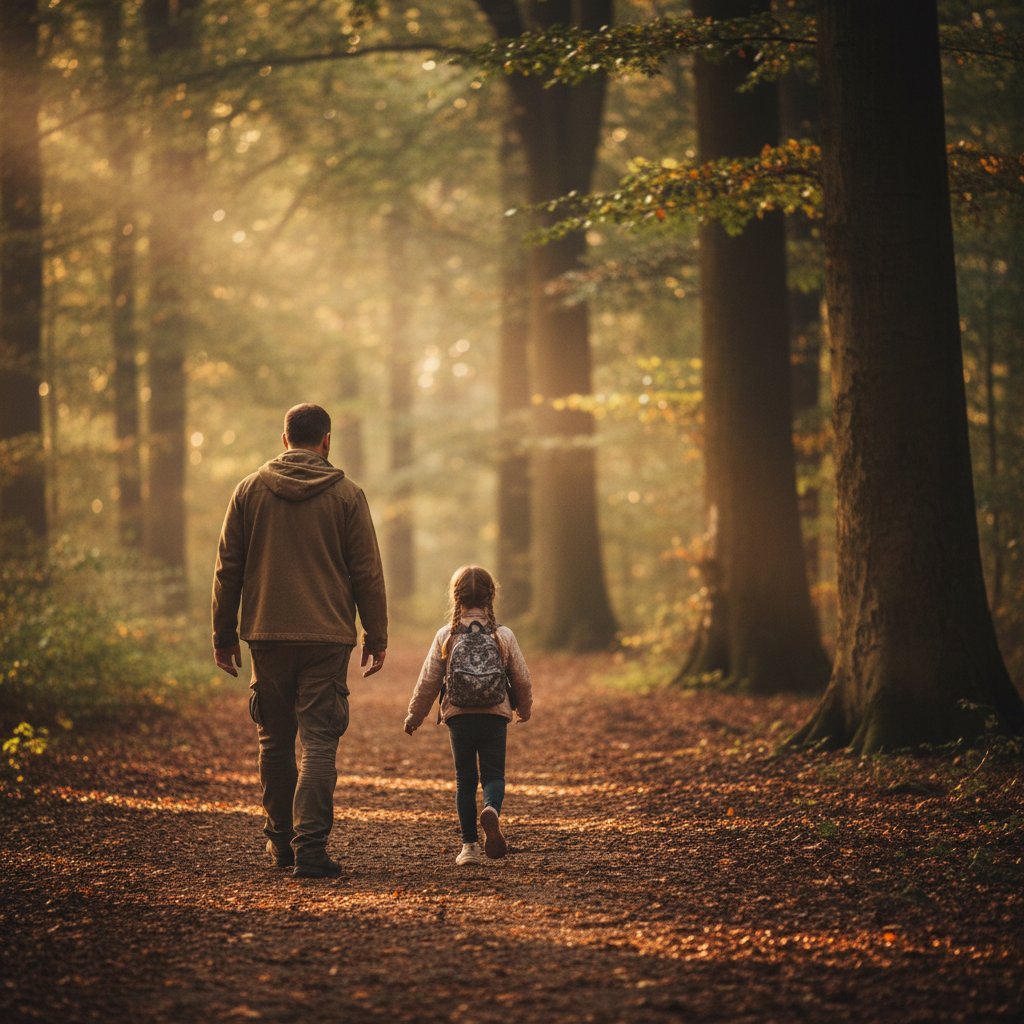
Something shifts when you walk alongside someone rather than facing them. Nature makes conversations easier, and often more honest.
Think about the last difficult conversation you had. Chances are, you were sitting face to face. Eye contact. The weight of being watched. The pressure to say the right thing, to react the right way. Now imagine having that same conversation while walking side by side, through trees, with nowhere particular to go.
It's different, isn't it? The intensity drops. The silence becomes comfortable. And often, without quite realising it, you start saying things you wouldn't have said sitting down.
Why side by side works
There's a simple reason walking side by side changes the dynamic. When you're not facing someone, the pressure of eye contact disappears. You're both looking ahead — at the path, the view, the world in front of you. The conversation becomes incidental, as if it's happening alongside the walking rather than being the point of it.
For a young person who finds direct conversation overwhelming, this is transformative. There's no spotlight. No expectation. Just two people moving in the same direction, with words that can come and go as they please.
The rhythm of walking
Walking has a natural rhythm that seems to unlock something in the way we think. Psychologists have studied this — the bilateral movement, the steady pace, the being outdoors. It calms the nervous system. It helps the brain process. It's why so many people do their best thinking on a walk.
For a young person carrying anxiety, grief or confusion, that rhythm is a gift. It gives their mind permission to wander. And sometimes, in that wandering, the thing they've been unable to say finally finds its way out.
Nature does the heavy lifting
The best conversations in mentoring often happen when you least expect them. Not during a planned session, but on the walk back. Not when you've asked a question, but when a bird has startled from a hedge and you've both stopped to watch it. The natural world provides a constant, gentle distraction that takes the pressure off — and in that space, honesty arrives.
You don't need to be a therapist to understand why this works. You just need to remember the last time you went for a walk with someone you trust, and how different it felt from sitting across a table.
"The best conversations happen when you stop trying to have them. Just walk. Just be there. The rest takes care of itself."
— Rich Moses, Founder